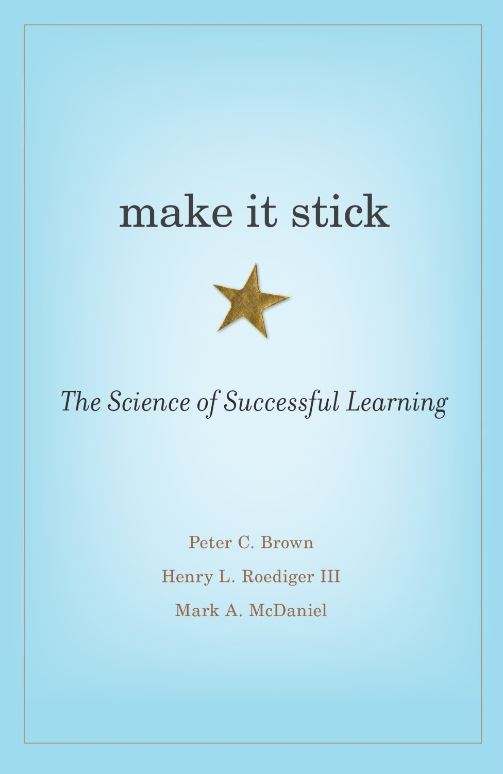
Peter C. Brown, Henry L. Roediger III, and Mark A. McDaniel, 336 pages, Belknap Press, April 2014
This is the book that changed everything for me. How could I get it so wrong for so long?
This is the book that every teacher and every student should read.
The authors offer easy and practical strategies to become more productive learners, strategies backed by empirical research, turning our common study habits on their head. Underlining and highlighting, rereading, cramming and repetition create an illusion of fluency and mastery but gains from those study strategies fade quickly. The preferred study techniques of learners of all stripes are among the least productive.
Right, you’ve heard it properly. We’re getting it all wrong. We misunderstand learning. What we believe about learning is wrong, not backed by science.
The preface to the book says it all…“People generally are going about learning in the wrong ways. Empirical research into how we learn and remember shows that much of what we take for gospel about how to learn turns out to be largely wasted effort. Even college and medical students— whose main job is learning— rely on study techniques that are far from optimal.” (Make it stick, The Science of Successful Learning).
Based on recent discoveries into cognitive psychology, the authors tell us how we learn, what works and does not work to learn and remember better, the most effective strategies that deepen learning and make it stick.
The book is packed with incredible takeaways, key insights on effective learning strategies, full of examples of people who have been successful in applying highly effective learning strategies backed by science.
You’ll be blown away, this book will captivate you, you’ll get back to it again and again.
The most important takeway for me was that retrieval practice, quizzing, putting things out of our brain is a very powerful learning tool.
What will be your major takeaway?
—
Learning is misunderstood.
Much research has been published in recent years on the science of learning, how we learn, effective learning strategies versus less effective practices, but we’re still going about learning in the wrong ways.
Why is that?
Primarily the most effective learning strategies are counterintuitive. We are misled by our intuition. Fluency does not mean mastery. Rereading gives a sense of familiarity, fluency with a text and it’s easy to mistake that fluency with mastery of the content. It is an illusion of mastery, it is not true mastery.
Effective learning also requires effort. Learning is deeper and more durable when it’s effortful. So many teachers believe that if they can make learning easier and faster, the learning will be better. That’s wrong. Much research turns this belief on its head: when learning is harder, it’s stronger and lasts longer.
“Learning that’s easy is like writing in sand, here today and gone tomorrow.”
Here the key takeaways, practical strategies that make learning effective as backed by empiral research.
1. To learn, retrieve
We need testing as a diptisk, as a measurement of progress but we need to rethink testing as a powerful learning tool.
“Practice at retrieving new knowledge or skill from memory is a potent tool for learning and durable retention,” the authors write.
In very short order we lose something like 70% of what we’ve just heard or read. We need to find a way to interrupt the process of forgetting.
The power of retrieval as a learning tool is known among psychologists as the testing effect or retrieval practice. Retrieving knowledge from memory makes learning stick far better than reexposure to the original material does.
Testing does not need to be initiated by the instructor. Students can practise retrieval, self-testing anywhere.
Retrieval practice (testing, quizzing) is far more effective to retain learning than time spent in reviewing, rereading the material, re-looking at a lecture or looking at our notes. It is retrieval from memory, taking information out of our brain, that deepens learning and makes it stick. Frequent retrieval, regular self-testing, quizzing by teachers help students lock in and reinforce learning, not having to cram for exams at the end of the course.
Without that knowledge being locked in and easy to be recalled, there is no way we can develop critical or creative thinking. This is the foundation of learning.
To be most effective, rerieval must be repeated again and again, in spaced out sessions so that the recall requires some cognitive effort. Repeated recall appears to help memory consolidates into a cohesive representation in the brain and to strengthen and multiply the neural routes by which the knowledge can be later retrieved. Repeated retrieval can so embed knowledge and skills that they become reflexive: the brain acts before the mind has time to think. This is critical for certain professions, if you’re a surgeon or a pilot.
Research shows that repeated testing, compared to rereading, can facilitate better transfer of knowledge to new contexts and problems. It is more than simply a way to expedite rote learning.
We’re all susceptible to illusions that can hijack our judgement of what we know and can do. Testing helps calibrate our judgment of what we’ve learned. In virtually all areas of learning, we build better mastery when we use testing as a tool to identify and bring up our areas of weakness.
While cramming can produce better scores on an immediate exam, the advantage quickly fades because there is much greater forgetting after rereading than after retrieval practice. The benefits of retrieval practice are long-term.
We’re easily seduced into believing that learning is better when it’s easier, but the research shows the opposite: when the mind has to work, learning sticks better. The greater the effort to retrieve learning, the more that learning is strengthened by retrieval. After an initial test, delaying subsequent retrieval practice is more potent for reinforcing retention than immediate practice, because delayed retrieval requires more effort. Self-testing may be unappealing because it takes more effort than rereading, but as noted already, the greater the effort at retrieval, the more will be retained.
A lot of us start by reading the material and then take questions while actually we should start with a question and read for the answer. If you start with a question and read for the answer, you’re going to get what you need and move on. Start by solving a problem. Trying to solve the problem before you are taught the solution is a powerful way of learning. When you are struggling and making errors, you become a sponge for the subsequent study.
Feedback. Studies shows that giving feedback strengthens retention even more than testing alone does. Giving students corrective feedback after tests keeps them from incorrectly retaining material they have misunderstood and produces better learning of the correct answers. Interestingly, some evidence shows that delaying the feedback briefly produces better long-term learning than immediate feedback. This finding is counterintuitive but is consistent with researchers’ discoveries about how we learn motor tasks. Immediate feedback is like the training wheels on a bicycle: the learner quickly comes to depend on the continued presence of the correction. Delayed feedback on written tests may help because it gives the student practice that’s spaced out in time.
While any kind of retrieval practice generally benefits learning, the implication seems to be that where more cognitive effort is required for retrieval, greater retention results. However, even a single test in a class can produce a large improvement in final exam scores, and gains in learning continue to increase as the number of tests increases.
Students generally dislike the ideas of tests, in particular in the case of high-stakes tests where the score comes with significant consequences. Yet, in all studies of testing, students who were frequently tested reached the end of the semester on top of the material and did not need to cram for exams.
Besides strengthening learning and retention, testing improves student attention. It increases studying before class (because students know they’ll be quizzed), increases attentiveness during class if students are tested at the end of class, and enables students to better calibrate what they know and where they need to bone up. Frequent low-stakes help dial down test anxiety: no single test is a make-or-break event. And this kind of testing enables instructors to identify gaps in students’ understanding and adapt their instruction to fill them.
2. Mix up your practice
It’s better to mix it up than focus solely on one thing. Our intuition about learning would suggest that just the opposite was true, but this is one of many areas in which our intuition about learning is not well supported by the research.
“Massed study” is the term researchers use to describe when students focus their studying entirely on one skill or set of knowledge before moving on to the next.
“Interleaving” is when students shift their studying back and forth between different topics on a regular basis.
“Faith in focused, repetitive practice of one thing at a time until we’ve got it nailed is pervasive among classroom teachers and students”. It is everywhere you look: boot camps, seminars where training is condensed into a single weekend with the promise of fast learning. Cramming for exams is a form of massed practice. It feels like a productive strategy, and it may get students through the next day’s exam but most of the material will be long forgotten by the time students sit down for their final exam.
Research shows that it is not the most effective learning strategy. Far from it.
While practicing is vital to learning and memory, studies have shown that practice is far more effective when it’s broken into separate periods of training that are spaced out.
Massed study produces short-term retention, which is why cramming for tests can be effective. But if you compare test scores with interleaving, students demonstrate much higher long-term retention, even though they often report feeling as if their studying was ineffective.
Practice that’s spaced out, interleaved with other learning, produces better mastery, longer retention, and more versatility. But these benefits come at a price: when practice is spaced, interleaved, it requires some effort. You feel the increased effort, but not the benefits the effort produces. Learning feels slower from this kind of practice, and you don’t get the rapid improvements from massed practice. Even in studies where the participants have shown superior results from spaced learning, they don’t perceive the improvement; they believe they learned better on the material where practice was massed. Spacing out feels less productive for the very reason that some forgetting has set in and students have got to work harder to recall the concepts. It does not feel like they are on top of it. Yet this added effort is making the learning stronger.
Interleaving is unpopular and seldom used. Teachers dislike it because it feels sluggish. Students find it confusing: they’re just starting to get a handle on new material and don’t feel on top of it yet when they are forced to switch. But the research shows unequivocally that mastery and long-term retention are much better if you interleave practice than if you mass it.
Why is spaced practice more effective? It appears that embedding new learning in long-term memory requires a process of consolidation where new learning is given meaning and connected to prior knwledge, a process that may take several days. Rapid-fire practice leans on short-term memory. Durable learning requires time. Hence, spaced practice works better. You learn better and apply it better if you mix up the concepts, skills, the brain gets a more sophisticated representation and is better able to figure out what kind of problem you are facing and the solution to it. Interleaving helps us learn better how to assess the context and discriminate between problems, selecting and applying the correct solution from a range of possibilities.
Stop teaching and learning in batches, keep circling back to things. Interleave, mix the concepts, mix the skills. This is counterintuitive. This is unconfortable. It builds muscle memory.
3. Embrace difficulties
Learning is at least a three-step process: initial encoding of information is held in short-term working memory before being consolidated into a cohesive representation of knowledge in long-term memory. Consolidation reorganizes and stabilizes memory traces, gives them meaning, and makes connections to past experiences and to other knowledge already stored in long-term memory. Retrieval updates learning and enables you to apply it when you need it.
Most of us believe that teaching should use strategies that make learning easier. Learning can be fun, but that doesn’t mean it should be easy.
Just like exercice, learning works the same way: no pain, no gain.
This is what Elizabeth and Robert Bjork calls ‘Desirable difficulties’, making things hard on yourself but in a good way. ‘ Difficulties’ in that they pose challenges (increased frequency of errors) but they are ‘desirable’ in that they foster the very goals of instruction: durable learning.
Testing, interleaving, spacing, mixing up practice are desirable difficulties. They require some effort. They feel less productive at the time but will more than compensate for that by making learning stronger, precise and enduring.
We should also embrace failure. In our Western culture, where achievement is seen as an indicator of ability, many learners view errors as failure and do what they can to avoid committing them. This fear of failure poisons learning. Even strategies that are highly likely to result in errors, like asking someone to try to solve a problem before being shown how to do it, produce stronger learning and retention of the correct information than more passive learning strategies, provided there is corrective feedback. Moreover, people who are taught that learning is a struggle that often involves making errors will go on to exhibit a greater propensity to tackle tough challenges and will tend to see mistakes not as failures but as lessons and turning points along the path to mastery.
4. Avoid illusions of knowing
Learning to be accurate self-observers helps us to stay out of blind alleys, make good decisions, and reflect on how we might do better next time. An important part of this skill is being sensitive to the ways we can delude ourselves.
The truth is that we’re all hardwired to make errors in judgement. Good judgement is a skill one must acquire, becoming an astute observer of one’s own thinking and performance. We start at a disadvantage for several reasons. One is that when we’re incompetent, we tend to overestimate our competence and see little reason to change (this is called the Dunning-Kruger effect). Another is that, as humans, we are readily misled by illusions, cognitive biases, and the stories we construct to explain the world around us.
Fluency illusions result from our tendency to mistake fluency with a text for mastery of its content. For example, if you read a particularly lucid presentation of a difficult concept, you can get the idea that it is actually pretty simple and perhaps even that you knew it all along. As discussed earlier, students who study by rereading their texts can mistake their fluency with a text, gained form rereading, for possession of accessible knowledge of the subject and consequently overestimate how well they will do on a test.
Persistent illusions of knowing lead us to labor at unproductive strategies. The paradox is that those students who employ the least effective study strategies overestimate their learning the most, and, as a consequence of their misplaced confidence, they are not inclined to change their habits.
The good news is that we now know of simple and practical strategies that anybody can use, at any point in life, to calibrate our judgement: various forms of retrieval practice, such as low-stakes quizzing and self-testing to verify what we really know versus what we think we know, peer instruction, seeking feedback.
5. Go beyong learning styles
The idea that individuals have distinct learning styles has been around long enough to become part of the folklore of educational practice and an integral part of how many people perceive themselves.
The popular notion that you learn better when you receive instruction in a form consistent with your preferred learning style, for example as an auditory or visual learner, is not supported by empirical research.
It is more important that the mode of instruction matches the nature of the subject being taught: visual instruction for geometry, verbal instruction for poetry, and so on. When instructional style matches the nature of the content, all learners learn better, regardless of their differing preferences for how the material is taught.
People do have multiple forms of intelligence, and you learn better when you “go wide”, don’t limit instruction or experience to your preferred learning style but take command of your resources and tap all your “intelligences” to master the knowledge or skill you want to possess.
Consider your expertise to be in a state of continuing development, practice dynamic testing as a learning strategy to discover your weaknesses, and focus on improving yourself in those areas. It’s smart to build on your strengths, but you will become even more competent to improve in the areas where your knowledge or performance are not pulling their weight. Adopt active learning strategies like retrieval practice, spacing, and interleaving. Be aggressive. Like people with dyslexia who have become high achievers (Riichard Branson, DIane Swonk), develop workarounds or compensating skills for impediments or holes in your aptitudes.
6. Increase your abilities
The brain is remarkably plastic, mutable, something that reorganizes itself with each new task. Here three known cognitive strategies for getting more out of the mental horsepower you’ve already got: embracing a growth mindset, practicing like an expert, and constructing memory cues.
Growth mindset. “If you think you can, or you think you can’t, you’re right.” It turns out there is more truth than wit here. Attitude counts for a lot. The studies of psychologist Carol Dweck have gotten huge attention for showing just how big an impact one simple conviction can have on learning and performance: the belief that your level of intellectual ability is not fixed but rests to a large degree in your own hands.
When you try hard and learn something new, the brain forms new connections, and these new connections, over time, make you smarter. Intellectual development is not the natural unfolding of intelligence but results from the new connections that are formed through effort and learning. Effortful learning changes the brain. The growth mindset is a belief that intelligence is within our control. Our intellectual ability was not set at birth by the natural talents we were born with.
Dweck came to see that some students aim at performance goals, while others strive towards learning goals. In the first case, you’re working to validate your ability. In the second, you’re working to acquire new knowledge or skills. People with performance goals unconsciously limit their potential. If your focus is on validating or showing off your ability, you pick challenges you are confident you can meet. You want to look smart, so you do the same stunt over and over again. But if your goal is to increase your ability, you pick ever-increasing challenges, and you interpret setbacks as useful information that helps you to sharpen your focus, get more creative, and work harder. A focus on performance instead of on learning and growing causes people to hold back from risk taking.
Deliberate practice. Expert performance does not usually rise out of some genetic predisposition or IQ advantage. It rises from thousands of hours of what Anders Ericsson calls sustained deliberate practice. If doing something repeatedly might be considered practice, deliberate practice is a different animal: it’s goal-directed, often solitary, and consists of repeated striving to reach beyond your current level of performance. The striving, failure, problem solving, and renewed attempts that characterize deliberate practice build the new knowledge, physiological adaptations, and complex mental models required to attain ever higher levels.
Memory cues. Mnemonic devices are mental tools to help jold material in memory, cued for ready recall. A memory palace is a more complex type of mnemonic device that is useful for organizing and holding larger volumes of material in memory. It involves associating mental images with a series of physical locations to help cue memories. Humans remember pictures more easily than words.
It comes down to the simple but no less profound truth that effortful learning changes the brain, building new connections and capability. This is single fact, that our intellectual abilities are not fixed from birth but are, to a considerable degree, ours to shape, is a resounding answer to the nagging voice that too often asks us “Why bother?”. What we do shapes who we become and what we’re capable of doing. The more we do, the more we can do. And it comes down to the simple fact that the path to complex mastery or expert performance does not necessarily start from exceptional genes, but it most certainly entails self-discipline, grit, and persistence.
No matter what you may set your sights on doing or becoming, if you want to be a contender, it’s mastering the ability to learn that will get you in the game and keep you there.
Remember that the most succesful students are those who take charge of their own learning and follow a simple but disciplined strategy.
References
Brown, P.C., Roediger, H.L. and McDaniel, K.A. (2014) Make it Stick. The Science of Successful Learning. Cambrige: Harvard University Press.


Leave a Reply